


Sales & HR Development
Using the 70-20-10 Development Model to Build High-Performing Sales Leaders
Sales leaders face a unique set of pressures: delivering consistent revenue results, coaching teams, navigating regional market differences and building a unified and consistent sales culture across territories. For organizations, the question is rarely whether to develop sales leaders, but how to do it in a way that actually sticks.
Traditional, singular training events rarely build lasting sales leadership capability. One workshop or off-site program can introduce concepts, but it cannot replicate the judgment, adaptability, and coaching instincts that high-performing sales leaders need. Sales leaders are often reluctant to step ‘out’ of the demands of the sales cycle and are sensitive to any learning that isn’t practical and immediately applicable to their role. That is where the 70-20-10 development model offers a powerful, practical alternative to learn in the flow of work or through a focused experience.
What Is the 70-20-10 Development Model?
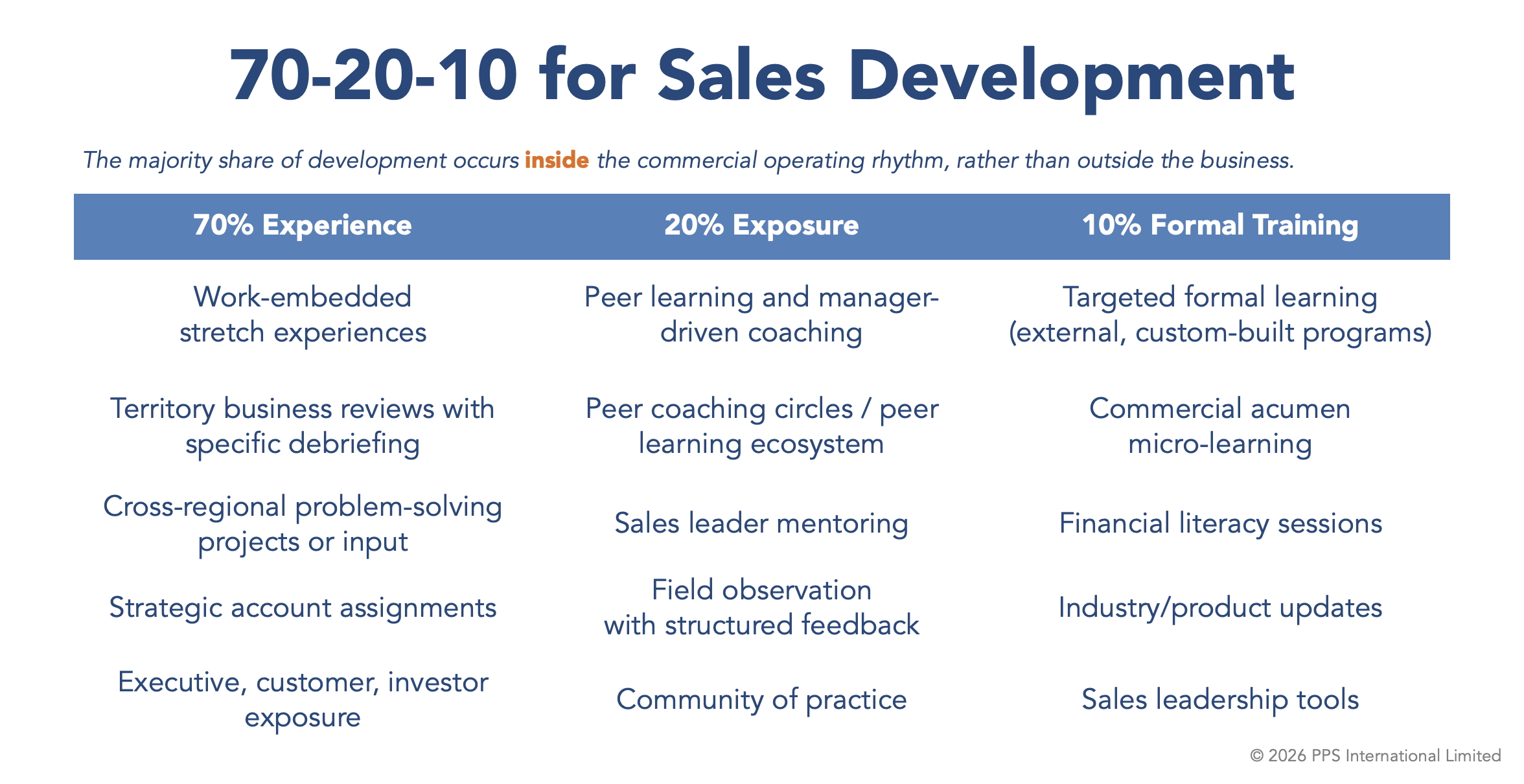
The 70-20-10 model is a leadership development framework that recognizes most leadership growth happens through experience (70%), learning through others (20%), and targeted formal learning (10%). Rather than pulling sales leaders out of their roles for periodic training, this model intentionally weaves learning and development opportunities into moments that already matter: pipeline reviews, forecasting meetings, quarterly business reviews, territory planning, ride-alongs, team calls and account strategy sessions.
70-20-10 Development Activities for Sales Leaders
70%: Work-Embedded Stretch Experiences
The largest share of learning and development comes from work-embedded stretch experiences. In a sales environment, this means designing growth into the moments that already exist in the business cadence. Specific stretch activities for sales leaders might include:
- Leading territory business reviews
- Taking on strategic account assignments
- Participating in cross-regional problem-solving projects
- Practicing high-stakes decision-making under ambiguity in real life situations
These experiences help build commercial execution, business acumen and strategic account thinking without requiring time away from business priorities. Development happens because the work is designed with intention.
20%: Learning through Others
Field sales leaders often operate independently, travel heavily, and have limited natural opportunities for peer connection and reflection. This makes the “20” especially valuable in a sales context.
Peer coaching circles, leader mentoring, field observation with structured feedback, and communities of practice all create space for reflection, shared problem-solving and consistency across regions. When sales leaders regularly hear how peers handle similar challenges, they build both skill and a more cohesive sales culture.
This is also where manager capability comes into sharpest focus. Managers in a 70-20-10 system are not just directing activity; they are observing, questioning, coaching, and connecting business challenges to development opportunities. A well-designed “20” builds better leaders at every level of the sales organization.
10%: Formal Learning
Formal learning still has a role, but it should be precise and practical. For sales leaders, the most effective formal learning tends to be tightly scoped, including targeted sessions such as commercial acumen micro-learning, financial literacy sessions, sales leadership tools, product updates or custom-built learning programs.
The critical design principle here is connection. Formal learning that does not link back to real work challenges or upcoming business priorities will not transfer. When it does connect, it accelerates the growth happening in the 70% and 20%.
Reinforcing the Sales Manager’s Role Using Development
One of the most underappreciated benefits of a strong 70-20-10 approach is how it reinforces the manager’s role. Instead of simply directing, managers learn to observe, inquire, develop and expose their people to growth opportunities. They coach, debrief deals, provide feedback and help sales leaders translate business challenges into development opportunities. When development is embedded in business activities rather than delegated to training events, managers are able to become active developers of their teams.
For organizations seeking stronger sales performance, better leadership consistency, and more cohesive regional teams, this shift in the manager’s role is often as valuable as any formal program.
Designing Sales Leadership Development as a Business System
For talent development leaders, the practical opportunity is to stop treating sales leadership development as an event and start designing it as a business-embedded system.
That system includes:
- Assessment to identify the capabilities each sales leader needs to build.
- Experience design that intentionally places leaders in stretch situations.
- Coaching and peer learning structures that drive reflection and consistency.
- Targeted instruction that fills specific knowledge gaps when they arise.
Ready to Build a Stronger Sales Leadership Pipeline?
PPS International Limited helps organizations design processes to develop sales leaders through experiences that are practical, measurable and embedded in the business cadence. Whether you are building a program from the ground up or looking to make your existing approach more effective, we can help you get there.
Talk to a PPS consultant about developing your sales leaders.
Recent Posts
Filter





We’re ready for you.
We enjoy discussing possibilities and approaches, so please reach out! Contact PPS International Limited today to explore how we can support your talent development initiatives.

PPS International Limited is a trusted learning and development partner empowering teams of all sizes with leadership, communication, influence, sales and professional skills training that drives meaningful business results.
© 2026 PPS International Limited. All Rights Reserved